Someone has a secret, nobody’s story quite adds up, and your detective could probably use a nap. Welcome to mystery writing. This thirty-day challenge will help you develop a mystery through daily exercises in character, clues, suspense, and the satisfying business of catching someone in a lie.
You’ll work on the same mystery throughout the month, building a collection of scenes and a plan for how the pieces fit together. You don’t need a complete plot before you begin. You do need to be willing to ask inconvenient questions of imaginary people.
How to Use This Challenge
Aim for fifteen to thirty minutes each day. Some days call for a scene; others ask for a short list or a little planning. Continue when an idea catches your interest, and come back tomorrow when it doesn’t.
Your mystery can involve a murder, a disappearance, a theft, sabotage, or a family secret. Choose something that makes you want to know what happened. If you need an opening, try one of the 15 First-Sentence Story Prompts for Mystery Writers.
By the end, you’ll have several key scenes and a working outline to help you turn them into a complete story. There is no prize for catching up perfectly if you miss a day. The suspects can wait.
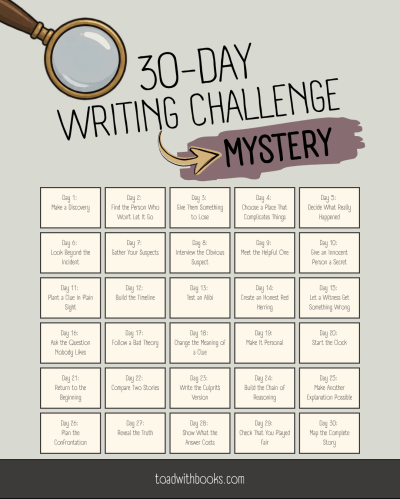
Days 1–5: Something Is Wrong
Day 1: Make a Discovery
Write a scene in which someone finds something that shouldn’t be there—or notices something that should be there but isn’t. Start close to the discovery. End with a question your character cannot immediately answer.
Day 2: Find the Person Who Won’t Let It Go
Introduce your investigator through an ordinary task. Show one useful strength and one habit that could get in their way. They might be a professional detective, a nosy neighbor, or someone who would very much prefer this to be somebody else’s problem.
Day 3: Give Them Something to Lose
Write the moment your investigator decides to get involved. Make walking away cost them something personal: a friendship, their livelihood, someone’s trust, or the chance to put an old mistake right.
Day 4: Choose a Place That Complicates Things
Describe your main setting through your investigator’s eyes. Include three details that could affect the investigation, such as a door that sticks, a noisy machine, or a window overlooking an alley. Sketch a simple layout if location matters.
Day 5: Decide What Really Happened
Privately write a rough account of the truth: who caused the central event, what they wanted, what they did, and what they hoped everyone would believe. This is your working answer, and you can revise it later. Your investigator does not get to read it.
Days 6–10: Meet the People With Something to Hide
Day 6: Look Beyond the Incident
Give the victim, missing person, or owner of the stolen object a life outside the mystery. Write a scene from before the incident that shows a desire, a difficult relationship, and a detail someone will remember differently afterward.
Day 7: Gather Your Suspects
Create three plausible suspects, including the person responsible. For each, note their connection to the incident, a possible motive, their opportunity, and one fact that seems to count against their involvement.
Day 8: Interview the Obvious Suspect
Write an interview with the person everyone immediately suspects. Give them a convincing reason to look guilty and a truthful answer that doesn’t fit your investigator’s theory. Let them be more complicated than their reputation.
Day 9: Meet the Helpful One
Write a conversation with a suspect who seems unusually willing to help. Have them offer useful information while steering attention away from something they would rather not discuss. Decide whether they are protecting themselves or someone else.
Day 10: Give an Innocent Person a Secret
Choose a suspect who did not cause the central incident. Give them another reason to lie, then write the moment your investigator notices the lie. Make the hidden truth consequential enough to justify their behavior.
Days 11–15: Leave Something Behind
Day 11: Plant a Clue in Plain Sight
Return to your discovery scene and add a concrete clue: an object, a sound, a mark, or a specific choice of words. Give it an ordinary interpretation now and a more revealing meaning once the truth is known.
Day 12: Build the Timeline
Map the important events before, during, and after the incident. Separate confirmed times from estimates and unsupported claims. Find one gap your investigator will need to explain.
Day 13: Test an Alibi
Write a scene in which your investigator checks someone’s account against an independent detail—a receipt, a witness, a journey time, or a recording. Let the check establish something useful without answering every question.
Day 14: Create an Honest Red Herring
Introduce a real fact that points toward the wrong explanation. Decide what actually caused it and how that truth will eventually emerge. The evidence should mislead because of how someone interprets it.
Day 15: Let a Witness Get Something Wrong
Write a conversation with a witness who sincerely believes an inaccurate detail. Work out why they made the mistake and plant a way to correct it later. They might have assumed an identity, confused two occasions, or heard only part of an exchange.
Days 16–20: Make the Investigation Uncomfortable
Day 16: Ask the Question Nobody Likes
Write an interview in which your investigator presses on a sensitive subject. Show discomfort through pauses, movement, or a change in tone. Let the response reveal a relationship or pressure the investigator hadn’t understood.
Day 17: Follow a Bad Theory
Have your investigator act on a reasonable but incorrect explanation. Make it cost them something: time, access, goodwill, or an innocent person’s trust. Include one detail that will later help them recognize the mistake.
Day 18: Change the Meaning of a Clue
Bring back an earlier clue alongside new information. The clue itself stays the same, but its significance changes. Write the moment your investigator realizes that something they treated as unimportant deserves another look.
Day 19: Make It Personal
Let someone affected by the investigation confront your investigator. Perhaps a friend feels used, a relative has been exposed, or a witness regrets cooperating. Write a scene in which pursuing the truth threatens a relationship that matters.
Day 20: Start the Clock
Introduce a deadline that fits your story. A building will be cleared, a suspect is leaving, an inheritance will be distributed, or an innocent person is about to face consequences. Show why waiting now has a cost.
Days 21–25: Find the Shape of the Answer
Day 21: Return to the Beginning
Send your investigator back to the original location, account, or discovery. Let their experience change what they notice. Use a detail you have already introduced to raise a sharper question.
Day 22: Compare Two Stories
Place two accounts of the same event side by side. Find a contradiction that matters, then write your investigator checking it. Decide whether the discrepancy comes from a lie, a mistake, or two people observing different parts of the truth.
Day 23: Write the Culprit’s Version
Write a private scene from the responsible person’s perspective during or just after the incident. Include a choice that leaves evidence behind. Compare it with your timeline and adjust anything that no longer makes sense.
Day 24: Build the Chain of Reasoning
List the steps that connect the available evidence to the solution. Identify what supports each step and what still relies on a guess. Give your investigator a plausible way to verify the most important uncertainty.
Day 25: Make Another Explanation Possible
Write the strongest alternative explanation your investigator could still believe. Then identify an established fact that rules it out. If nothing does, revise or add an earlier clue so the final conclusion will feel earned.
Days 26–30: Bring It All Together
Day 26: Plan the Confrontation
Decide where and how your investigator will confront the responsible person. Give the investigator a goal beyond delivering a speech: recovering something, protecting someone, securing evidence, or testing one last claim.
Day 27: Reveal the Truth
Write the confrontation or discovery scene. Let the solution emerge through specific evidence and the other person’s responses. A confession can add emotion or detail, but make sure the explanation holds together without one.
Day 28: Show What the Answer Costs
Write a scene after the mystery is solved. Who feels relieved? Who is grieving, embarrassed, angry, or suddenly uncertain about someone they trusted? Resolve one personal thread you introduced earlier.
Day 29: Check That You Played Fair
Review your scenes and notes. Could the reader encounter the important clues before the reveal? Do the timeline, motives, and opportunities fit? Explain your red herrings, and revise any moment that depends on a character ignoring something obvious.
Day 30: Map the Complete Story
Arrange your scenes and notes into a beginning-to-end outline. Mark the missing scenes and give each one a purpose. Then revise your opening so it creates the right question for the mystery you’ve actually built.
The Case Isn’t Closed Yet
You now have the groundwork for a mystery: people with competing interests, evidence that changes meaning, and an investigator with a reason to keep going. Your next step is to fill the gaps between those scenes and follow the story through.
Keep the parts that surprised you. Rework the clues that do too much or too little. And if your original culprit no longer fits, you’re allowed to change your mind—just remember to fix the evidence. Fictional suspects deserve at least that much due process.


Leave a Reply