Because “just write better” is surprisingly unhelpful advice.
If you’ve spent any time looking up writing advice, you’ve probably encountered phrases like show, don’t tell, find your voice, raise the stakes, and kill your darlings.
Writers throw these terms around as though everyone attended some secret meeting where they explained what they actually mean.
The problem is that knowing a writing rule exists isn’t the same as understanding how to use it. And following every rule religiously can make your writing sound just as unnatural as ignoring them altogether.
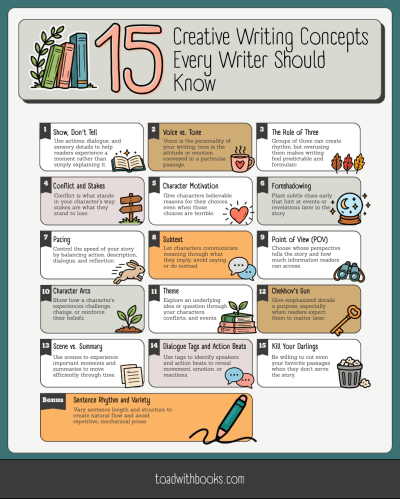
Whether you’re working on your first short story, struggling through a novel, or trying to figure out why a scene isn’t working, these 15 creative writing concepts can help you become a more intentional writer.
No creative writing degree required.
1. Show, Don’t Tell
What it means: Instead of directly explaining what a character feels or experiences, use actions, dialogue, and sensory details to help readers understand it.
Telling:
Sarah was nervous about the interview.
Showing:
Sarah smoothed her skirt for the third time. Her interview was in two minutes, and she’d already forgotten the name of the person she was supposed to meet.
The second example lets readers recognize Sarah’s nervousness without explicitly naming it.
When to use it: Showing works particularly well during emotional moments, important interactions, and scenes where you want readers to feel immersed in the action.
But here’s the part people sometimes forget: telling isn’t bad writing.
Sometimes you need to summarize three uneventful weeks in a sentence rather than drag readers through every single day.
The goal isn’t to eliminate telling. It’s to know when a moment deserves more attention.
2. Voice vs. Tone
Voice and tone are closely related, but they’re not interchangeable.
Voice is the distinctive personality of the writing. It comes from word choice, sentence structure, perspective, and the narrator’s way of observing the world.
Tone is the attitude or emotional quality conveyed in a particular passage.
Consider these examples:
Sarcastic voice, lighthearted tone:
Apparently, my brilliant plan to become a morning person had one tiny flaw: mornings.
Sarcastic voice, bitter tone:
He’d promised to change. Apparently, he’d forgotten to mention that the changes would all be for the worse.
Both examples have a similar voice, but their emotional tones are different.
When to use it: Understanding this distinction helps you maintain a recognizable narrative voice while allowing the mood to change naturally throughout your story.
A character can be sarcastic when they’re happy and still sound like themselves when they’re grieving.
3. The Rule of Three (And Why You Should Break It)
Traditionally, the rule of three suggests that ideas presented in groups of three are more memorable and satisfying.
It’s a familiar technique in storytelling, speeches, and comedy.
But there’s a downside.
When every description contains three adjectives, every argument has three points, and every paragraph ends with a perfectly balanced three-part statement, the writing starts feeling formulaic.
This pattern is especially noticeable in AI-generated content, which often leans heavily on symmetrical lists and predictable sentence structures.
Overused:
The house was dark, silent, and mysterious.
More effective:
The house was dark. Someone had left the kitchen light on, though nobody had lived there in years.
The second example replaces a generic list with a specific detail that creates tension.
When to use it: Groups of three can be effective for comedy, emphasis, and deliberate rhythm. But they shouldn’t become your default sentence structure.
Sometimes two details are enough. Sometimes you need four. Sometimes one carefully chosen image does more work than an entire list.
And while three-part lists aren’t proof that something was written by AI, repeating the same pattern constantly can make your writing sound mechanical.
The takeaway: Use the rule of three when it serves a purpose, not because three is supposedly the magic number.
4. Conflict and Stakes
Conflict and stakes are two of the most important ingredients in storytelling.
Conflict is whatever prevents your character from getting what they want.
Stakes are what the character stands to gain or lose.
Basic example:
Emma wants to win a baking competition.
Stronger example:
Emma needs to win the baking competition because the prize money is her last chance to save the bakery her grandmother left her.
The competition provides the conflict. Losing the bakery creates the stakes.
Stakes don’t have to involve death, destruction, or saving the entire world.
Losing someone’s trust can be devastating. So can missing an opportunity that will never come again.
When to use it: If your story feels like a series of events rather than a compelling narrative, ask yourself:
What does my character want? What’s stopping them? Why does it matter?
If you can’t answer those questions, you’ve probably found something worth revisiting.
5. Character Motivation
Motivation is the reason behind a character’s choices.
It’s what makes their actions understandable, even when those actions are questionable.
Imagine two siblings fighting over their childhood home.
One wants to keep it because it’s the last connection to their parents.
The other wants to sell it because they’re drowning in debt.
Neither character has to be the villain. Their conflicting motivations create the tension.
When to use it: Before writing a major decision, consider what your character believes they’ll gain by making it.
A character doesn’t need to make good decisions. They need to make decisions that make sense for who they are.
6. Foreshadowing
Foreshadowing involves planting hints about events that will happen later.
Done well, it makes readers look back and realize the clues were there all along.
Example:
Before leaving for vacation, Daniel notices the basement door is unlocked. He locks it and forgets about it.
Three chapters later, he discovers someone has been living beneath his house.
That small detail suddenly becomes much more important.
When to use it: Foreshadowing is especially useful in mysteries, thrillers, and stories involving secrets or major revelations.
You don’t need to announce that something is suspicious. In fact, it’s usually better if you don’t.
7. Pacing
Pacing determines how quickly a story moves.
Fast pacing can create urgency. Slower pacing gives readers time to absorb information or connect with characters.
Fast pacing:
The door slammed. Footsteps followed. She ran.
Slower pacing:
She stood in the empty hallway, listening to the old house settle around her. Somewhere upstairs, a floorboard creaked.
Neither version is inherently better.
A suspenseful scene might benefit from short, abrupt sentences. A reflective scene might need more room.
When to use it: Pay attention to how long you spend on individual moments.
If a supposedly urgent scene includes three pages of irrelevant description, you might be slowing things down at exactly the wrong time.
8. Subtext
Subtext is what characters communicate without directly saying it.
People rarely express every feeling perfectly, especially when they’re upset or trying to hide something.
Direct dialogue:
“You’re angry because I forgot your birthday.”
“Yes, I’m angry.”
Dialogue with subtext:
“I brought you flowers.”
“That’s nice. What day is it?”
“Thursday.”
“Exactly.”
The characters never explicitly discuss the forgotten birthday, but the tension is obvious.
When to use it: Subtext is particularly effective in arguments, romantic scenes, complicated relationships, and conversations involving secrets.
Sometimes what a character refuses to say is more revealing than what they actually say.
9. Point of View (POV)
Point of view determines whose perspective readers experience the story through.
Common choices include:
First person: I opened the door.
The narrator tells the story from their own perspective.
Second person: You open the door.
The narrative addresses the reader or a character as “you.”
Third-person limited: She opened the door, hoping he wasn’t inside.
The narration follows a particular character’s perspective.
Third-person omniscient: The narrator can reveal the thoughts and experiences of multiple characters.
Each option changes what readers know and how closely they experience the story.
When to use it: Consider whose perspective will make your story most compelling.
A mystery told from the detective’s perspective creates a different experience than one told by the murderer.
10. Character Arcs
A character arc describes how a character changes, or resists changing, throughout a story.
For example, a woman who refuses to trust anyone after a betrayal might gradually learn to rely on others.
Her experiences challenge the beliefs she held at the beginning.
But not every character needs a dramatic transformation.
Some characters remain steadfast while the world around them changes.
When to use it: Think about what your main character believes at the beginning of the story.
Then ask how the events of the plot might challenge that belief.
11. Theme
Theme is the underlying idea or question explored through a story.
Common themes include forgiveness, identity, belonging, power, and freedom.
For example, a novel about estranged siblings returning home after their father’s death might explore forgiveness.
The plot is what happens. The theme is what those events explore.
When to use it: You don’t have to decide on a theme before writing your first sentence.
Sometimes themes emerge naturally as your characters develop.
You can strengthen those ideas during revision without turning your story into a lecture.
12. Chekhov’s Gun
Chekhov’s Gun is the principle that details given significant attention should generally serve a purpose.
If a writer makes a point of describing a loaded gun hanging on the wall, readers will expect it to matter later.
That doesn’t mean every object in your story needs to become a plot twist.
Example:
Early in a mystery, a character mentions that the back door sticks unless you lift it while turning the handle.
Later, the detective realizes the supposed intruder couldn’t have entered that way without knowing the trick.
When to use it: During revisions, look for details you’ve emphasized but never used.
Also look for important revelations that seem to appear out of nowhere. A little earlier setup might make them more satisfying.
13. Scene vs. Summary
A scene allows readers to experience events as they happen.
A summary condenses events to move the story forward.
Summary:
Over the next three weeks, Mia avoided her sister’s phone calls.
Scene:
Mia watched her sister’s name flash across the screen. For the fourth time that week, she pressed Decline.
The summary moves through time quickly. The scene focuses on a specific moment.
When to use it: Use scenes for important decisions, emotional turning points, and meaningful interactions.
Use summaries for transitions and events that don’t need detailed attention.
Not every trip to the grocery store deserves its own chapter.
14. Dialogue Tags and Action Beats
Dialogue tags identify who’s speaking.
Dialogue tag:
“I don’t believe you,” she said.
Action beats describe what a character is doing during a conversation.
Action beat:
“I don’t believe you.” She folded the letter and slipped it into her pocket.
Action beats can communicate emotion without explicitly explaining it.
They also help readers picture the characters interacting with their surroundings.
When to use it: Combine simple dialogue tags with meaningful action beats.
And don’t be afraid of the word “said.”
Readers barely notice it, which is exactly why it works.
Your characters don’t need to declare, exclaim, mutter, or hiss every sentence.
15. Kill Your Darlings
This phrase means being willing to remove writing you love when it doesn’t serve the story.
Maybe you’ve written a beautiful description that interrupts an action scene.
Maybe there’s a funny conversation that doesn’t advance the plot or reveal anything meaningful.
Or maybe you’ve created an entire character because you liked their name.
It happens.
Example:
Your character is running from someone dangerous, but you’ve interrupted the chase with three paragraphs describing the sunset.
The description might be lovely.
It might also be ruining the scene.
When to use it: During revisions, ask whether a passage contributes something worthwhile.
If it doesn’t, consider cutting it or moving it elsewhere.
And if deleting your favorite paragraph feels unbearable, save it in another document.
You can always find a home for it later.
Bonus: Sentence Rhythm and Variety
This isn’t really a bonus so much as something that affects nearly everything else on this list.
Sentence rhythm is the way your writing flows through variations in length, structure, and emphasis.
Consider this passage:
She opened the door. She walked into the room. She looked around. She noticed the window was open.
There’s nothing grammatically wrong with it. But the repeated structure makes the passage feel stiff.
Now compare:
She opened the door and stepped inside. The window was open. Strange. She was certain she’d closed it before leaving.
The second version varies its sentence lengths and creates a more natural rhythm.
Repetition can be effective when it’s intentional. The problem is repetition that happens because you’ve fallen into a pattern without noticing.
This is also why relying too heavily on three-part lists can make writing sound artificial.
Try this: Read a paragraph aloud. Listen for sentences that begin the same way, repeated rhythms, and descriptions that feel unnecessarily balanced.
If you can predict the structure of the next sentence before reading it, consider changing things up.
How to Put These Writing Concepts Into Practice
You don’t need to memorize every term before writing your next story.
Instead, choose a scene you’ve already written and examine it with a few questions in mind:
- Does my character want something specific?
- What happens if they don’t get it?
- Am I showing important moments and summarizing less important ones?
- Does the dialogue sound like something these characters would actually say?
- Am I repeating the same sentence patterns?
- Does every important detail contribute something to the story?
You don’t have to fix everything in one revision.
Start with the biggest problem and work your way down.
Writing Rules Are Tools, Not Commandments
One of the most frustrating things about writing advice is how often it’s presented as absolute.
Never use adverbs. Always show instead of tell. Write every day. Follow the rule of three.
But good writing isn’t about checking off a list of rules.
Sometimes telling is more effective than showing. Sometimes a simple dialogue tag works better than an elaborate action beat. And sometimes the best sentence is the one that breaks every rule you’ve been told to follow.
Understanding these concepts gives you more choices as a writer.
The goal isn’t to make every sentence technically perfect. It’s to write something people actually want to keep reading.
And that usually starts with knowing why something works, rather than blindly following advice from someone on the internet.
Yes, including this advice.


Leave a Reply