
In the realm of writing, whether crafting a story, essay, or blog post, the choice of words is crucial. Words hold the power to evoke emotions, paint vivid imagery, and captivate readers. However, falling back on overused or generic descriptive words can dampen the impact of your writing. Let’s explore how to elevate your prose by replacing common descriptive words with more dynamic alternatives.
The Pitfalls of Common Descriptive Words
Certain words have become staples in writing but can feel uninspired or lackluster when used repeatedly. Words like “good,” “bad,” “nice,” and “big” are simple and convenient but often fail to convey the precise meaning or depth of a subject. For instance, describing a meal as “good” doesn’t do justice to its flavors, textures, and overall experience.
Upgrade Your Vocabulary
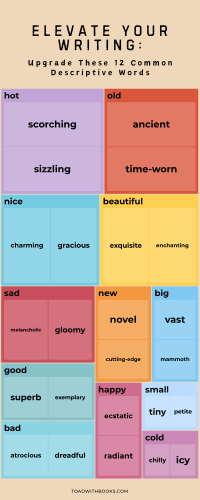
To invigorate your writing, consider replacing mundane words with more specific, evocative alternatives. Here are some suggestions to get you started:
1. Good
While “good” is a go-to descriptor for many situations, its versatility often lacks the depth needed to truly convey excellence.
Upgrade to:
- Superb: Exceedingly good; of the highest quality.
- Exemplary: Worthy of imitation; outstanding.
2. Bad
“Bad” is a broad term that can encompass anything from mildly unfavorable to downright catastrophic.
Upgrade to:
- Atrocious: Extremely bad; shockingly awful.
- Dreadful: Causing great suffering, fear, or unhappiness.
3. Nice
“Nice” is a vague catch-all term that can be easily surpassed by more precise alternatives.
Upgrade to:
- Charming: Delightfully pleasing; attractive in a subtle way.
- Gracious: Characterized by kindness and warm courtesy.
4. Big
While “big” effectively conveys size, it lacks the descriptive punch needed for more evocative writing.
Upgrade to:
- Vast: Of very great extent or quantity; immense.
- Mammoth: Extremely large; gigantic.
5. Small
Similarly, “small” is serviceable but often falls short in conveying the nuanced scale of something diminutive.
Upgrade to:
- Tiny: Extremely small; minuscule.
- Petite: Delicately small and pretty.
6. Hot
Describing something as “hot” can be rather bland. Let’s turn up the heat with more vivid alternatives.
Upgrade to:
- Scorching: Extremely hot; burning.
- Sizzling: Very hot, with a hissing sound.
7. Cold
“Cold” is another word that could benefit from more colorful synonyms to paint a clearer picture.
Upgrade to:
- Chilly: Uncomfortably cool.
- Icy: Very cold; frosty.
8. Happy
To capture the full spectrum of joy and contentment, we need descriptive words that sparkle with emotion.
Upgrade to:
- Ecstatic: Feeling overwhelming happiness or joyful excitement.
- Radiant: Emitting great joy, love, or health.
9. Sad
The feeling of sadness encompasses a range of emotions beyond mere unhappiness.
Upgrade to:
- Melancholic: Expressing deep sadness or sorrow.
- Gloomy: Dark or poorly lit, often reflecting a somber mood.
10. Old
“Old” can denote age but fails to capture the rich history and character often associated with antiquity.
Upgrade to:
- Ancient: Belonging to the very distant past; age-old.
- Time-worn: Marked by the passage of time; well-worn with age.
11. New
Conversely, “new” lacks the intrigue and freshness that can be conveyed by more imaginative words.
Upgrade to:
- Novel: Strikingly new, unusual, or different.
- Cutting-edge: Ahead of current trends; innovative.
12. Beautiful
While “beautiful” is a lovely descriptor, there are numerous alternatives that can add depth and texture to descriptions of aesthetics.
Upgrade to:
- Exquisite: Extremely beautiful and delicate.
- Enchanting: Delightfully charming or captivating.
Using Descriptive Words Effectively
The key to using descriptive words effectively lies in precision and context. Consider the following tips:
- Be specific: Tailor your word choice to convey the exact emotion, sensation, or image you intend.
- Consider connotations: Words carry subtle meanings and associations. Choose words that align with the tone and atmosphere of your writing.
- Avoid redundancy: Instead of stacking adjectives, opt for a single powerful word that encapsulates your meaning.
Experiment and Refine
As you incorporate richer vocabulary into your writing, allow yourself to experiment and refine your style. Pay attention to the impact of different words on the overall tone and mood of your piece. Embrace the versatility of language to bring your writing to life.
Expanding our arsenal of descriptive words empowers us to paint richer, more vivid pictures with our writing. By moving beyond the ordinary and embracing the extraordinary, we can captivate readers and convey our thoughts and emotions with greater clarity and impact. So, let’s embark on this linguistic adventure together, discovering new words and breathing fresh life into our writing. Your next masterpiece awaits—let your words shine!
 Toad with Books
Leave a comment