Dive into the timeless world of classic literature with this reading challenge! Whether you’re a seasoned reader or just starting to explore the classics, this challenge will guide you through a diverse selection of renowned works from different genres, time periods, and cultures. Expand your literary horizons and embark on a journey through some of the greatest stories ever written.
Challenge Rules:
- Choose a minimum number of classic books you aim to read within a specific timeframe (e.g., a year).
- Select books from the provided categories or customize your list with classic literature of your choice.
- Share your progress and insights with fellow readers through social media or a book club.
- Enjoy the experience of exploring different literary styles, themes, and cultures.
- Feel free to revisit any classics you’ve read before or discover new favorites along the way.
Categories:
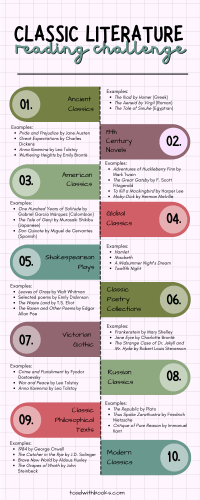
- Ancient Classics:
- Ancient classics refer to literary works from civilizations of antiquity, including Greek, Roman, Egyptian, Mesopotamian, and others. These texts often explore fundamental human experiences, societal values, and mythological themes that have endured through the ages. Reading ancient classics provides insight into the origins of storytelling and the foundations of Western and Eastern literature.
- Examples:
- “The Iliad” by Homer (Greek)
- “The Aeneid” by Virgil (Roman)
- “The Tale of Sinuhe” (Egyptian)
- Examples:
- Ancient classics refer to literary works from civilizations of antiquity, including Greek, Roman, Egyptian, Mesopotamian, and others. These texts often explore fundamental human experiences, societal values, and mythological themes that have endured through the ages. Reading ancient classics provides insight into the origins of storytelling and the foundations of Western and Eastern literature.
- 19th Century Novels:
- The 19th century was a period of significant literary development, characterized by the rise of the novel as a dominant form of literature. These novels often reflect the social, political, and cultural realities of the time, exploring themes such as love, class struggle, industrialization, and the individual’s place in society.
- Examples:
- “Pride and Prejudice” by Jane Austen
- “Great Expectations” by Charles Dickens
- “Anna Karenina” by Leo Tolstoy
- “Wuthering Heights” by Emily Brontë
- Examples:
- The 19th century was a period of significant literary development, characterized by the rise of the novel as a dominant form of literature. These novels often reflect the social, political, and cultural realities of the time, exploring themes such as love, class struggle, industrialization, and the individual’s place in society.
- American Classics:
- American classics encompass a diverse range of literary works that reflect the unique history, culture, and landscape of the United States. From tales of frontier life to examinations of the American Dream and societal issues, these novels offer insights into the American experience across different time periods and regions.
- Examples:
- “Adventures of Huckleberry Finn” by Mark Twain
- “The Great Gatsby” by F. Scott Fitzgerald
- “To Kill a Mockingbird” by Harper Lee
- “Moby-Dick” by Herman Melville
- Examples:
- American classics encompass a diverse range of literary works that reflect the unique history, culture, and landscape of the United States. From tales of frontier life to examinations of the American Dream and societal issues, these novels offer insights into the American experience across different time periods and regions.
- Global Classics:
- Global classics include literary masterpieces from various countries and cultures around the world. These works offer readers the opportunity to explore different perspectives, traditions, and storytelling techniques beyond their own cultural boundaries. From magical realism to epic poetry, global classics celebrate the richness and diversity of human expression.
- Examples:
- “One Hundred Years of Solitude” by Gabriel García Márquez (Colombian)
- “The Tale of Genji” by Murasaki Shikibu (Japanese)
- “Don Quixote” by Miguel de Cervantes (Spanish)
- Examples:
- Global classics include literary masterpieces from various countries and cultures around the world. These works offer readers the opportunity to explore different perspectives, traditions, and storytelling techniques beyond their own cultural boundaries. From magical realism to epic poetry, global classics celebrate the richness and diversity of human expression.
- Shakespearean Plays:
- The plays of William Shakespeare stand as timeless achievements in English literature, encompassing tragedy, comedy, history, and romance. Shakespeare’s works delve into the complexities of human nature, morality, power, and love, offering enduring insights into the human condition.
- Examples:
- “Hamlet”
- “Macbeth”
- “A Midsummer Night’s Dream”
- “Twelfth Night”
- Examples:
- The plays of William Shakespeare stand as timeless achievements in English literature, encompassing tragedy, comedy, history, and romance. Shakespeare’s works delve into the complexities of human nature, morality, power, and love, offering enduring insights into the human condition.
- Classic Poetry Collections:
- Classic poetry collections feature the works of renowned poets from different literary movements and periods. From romantic odes to introspective sonnets, classic poetry explores themes of love, nature, mortality, and the sublime with eloquence and beauty.
- Examples:
- “Leaves of Grass” by Walt Whitman
- Selected poems by Emily Dickinson
- “The Waste Land” by T.S. Eliot
- “The Raven and Other Poems” by Edgar Allan Poe
- Examples:
- Classic poetry collections feature the works of renowned poets from different literary movements and periods. From romantic odes to introspective sonnets, classic poetry explores themes of love, nature, mortality, and the sublime with eloquence and beauty.
- Victorian Gothic:
- Victorian Gothic literature emerged during the 19th century and is characterized by its dark, atmospheric settings, macabre themes, and complex characters. These works often explore the supernatural, psychological terror, and societal anxieties of the Victorian era, reflecting the tensions between rationality and the unknown.
- Examples:
- “Frankenstein” by Mary Shelley
- “Jane Eyre” by Charlotte Brontë
- “The Strange Case of Dr. Jekyll and Mr. Hyde” by Robert Louis Stevenson
- Examples:
- Victorian Gothic literature emerged during the 19th century and is characterized by its dark, atmospheric settings, macabre themes, and complex characters. These works often explore the supernatural, psychological terror, and societal anxieties of the Victorian era, reflecting the tensions between rationality and the unknown.
- Russian Classics:
- Russian classics encompass a rich tradition of literature that flourished in Russia from the 19th century onwards. These novels delve into the complexities of Russian society, history, and spirituality, often through expansive narratives and profound philosophical insights.
- Examples:
- “Crime and Punishment” by Fyodor Dostoevsky
- “War and Peace” by Leo Tolstoy
- “Anna Karenina” by Leo Tolstoy
- Examples:
- Russian classics encompass a rich tradition of literature that flourished in Russia from the 19th century onwards. These novels delve into the complexities of Russian society, history, and spirituality, often through expansive narratives and profound philosophical insights.
- Classic Philosophical Texts:
- Classic philosophical texts offer profound explorations of metaphysics, ethics, epistemology, and the nature of existence. These works have shaped philosophical discourse for centuries and continue to provoke thought and debate on fundamental questions about life, knowledge, and reality.
- Examples:
- “The Republic” by Plato
- “Thus Spoke Zarathustra” by Friedrich Nietzsche
- “Critique of Pure Reason” by Immanuel Kant
- Examples:
- Classic philosophical texts offer profound explorations of metaphysics, ethics, epistemology, and the nature of existence. These works have shaped philosophical discourse for centuries and continue to provoke thought and debate on fundamental questions about life, knowledge, and reality.
- Modern Classics:
- Modern classics represent influential works of literature from the 20th and 21st centuries that have left a lasting impact on readers and society. These novels often grapple with contemporary issues, societal changes, and the complexities of human experience, offering new perspectives and insights for modern readers.
- Examples:
- “1984” by George Orwell
- “The Catcher in the Rye” by J.D. Salinger
- “Brave New World” by Aldous Huxley
- “The Grapes of Wrath” by John Steinbeck
- Examples:
- Modern classics represent influential works of literature from the 20th and 21st centuries that have left a lasting impact on readers and society. These novels often grapple with contemporary issues, societal changes, and the complexities of human experience, offering new perspectives and insights for modern readers.
Bonus Challenge:
- The bonus challenge encourages readers to step out of their comfort zone and tackle a classic work that may seem daunting or unfamiliar. By embracing this challenge, readers can expand their literary horizons and discover new depths of meaning and enjoyment in classic literature.
- Example:
- “Ulysses” by James Joyce
- “In Search of Lost Time” by Marcel Proust
- “The Brothers Karamazov” by Fyodor Dostoevsky
- Example:
Remember, the goal of this challenge is not just to check off boxes but to engage deeply with the literary treasures of the past, fostering a deeper appreciation for the classics and their enduring relevance in today’s world. Happy reading!
 Toad with Books
Leave a comment